Finding time to exercise can be difficult when you have a busy schedule. Between work, family, and daily responsibilities, spending an hour at the gym may not always be realistic. The good news is that you can still build an effective fitness routine with short, structured workouts.
HIIT Workouts for Fat Loss are a popular option for people who want challenging workouts without spending hours exercising. High-intensity interval training combines short periods of intense exercise with recovery periods, allowing you to work multiple muscle groups and elevate your heart rate in a limited amount of time.
A 10-minute workout can be a useful starting point for beginners or a quick addition to an existing fitness routine. When combined with consistent training, proper nutrition, strength exercises, and adequate recovery, HIIT Workouts for Fat Loss can become part of a sustainable fitness plan.
What Are HIIT Workouts?
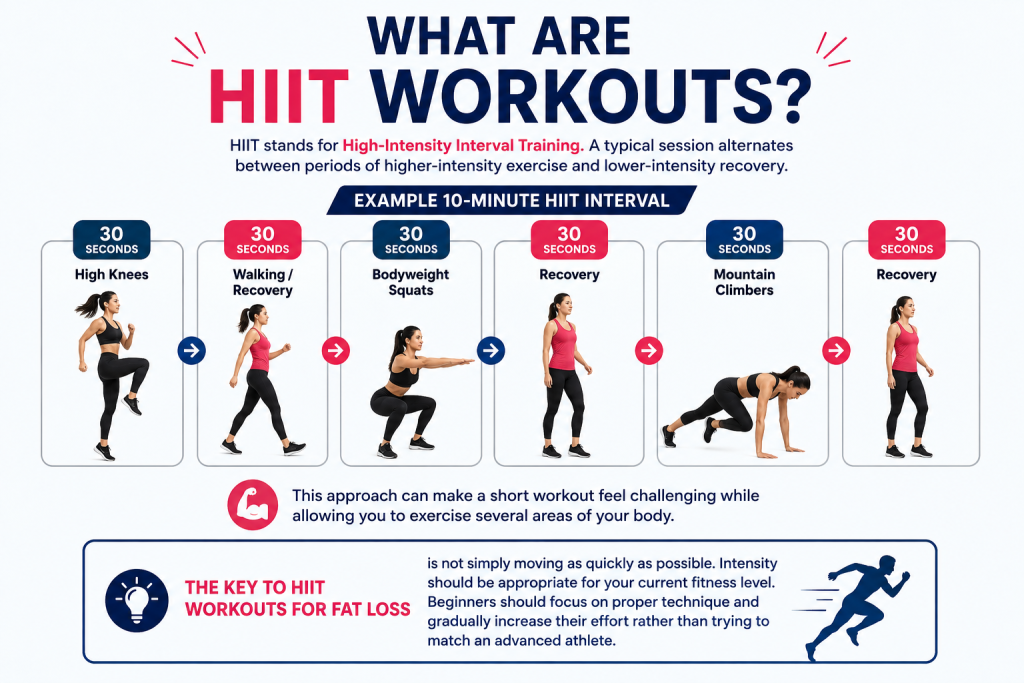
HIIT stands for high-intensity interval training. A typical session alternates between periods of higher-intensity exercise and lower-intensity recovery.
For example, you might perform:
- 30 seconds of high knees
- 30 seconds of walking or resting
- 30 seconds of bodyweight squats
- 30 seconds of recovery
- 30 seconds of mountain climbers
- 30 seconds of recovery
This approach can make a short workout feel challenging while allowing you to exercise several areas of your body.
The key to HIIT Workouts for Fat Loss is not simply moving as quickly as possible. Intensity should be appropriate for your current fitness level. Beginners should focus on proper technique and gradually increase their effort rather than trying to match an advanced athlete.
Why Try 10 Minute HIIT Workouts for Fat Loss?
One of the biggest advantages of a short workout is convenience. If you regularly struggle to fit exercise into your schedule, 10 minutes can be easier to commit to than a long gym session.
HIIT Workouts for Fat Loss may also help you build exercise consistency. Instead of skipping a workout because you only have a few minutes, you can complete a short session and continue with your day.
Other potential benefits include:
- Efficient use of workout time
- Improved cardiovascular fitness
- Increased exercise variety
- Full-body movement
- Easy progression for different fitness levels
- Convenient home or gym training
However, fat loss depends on several factors, including overall calorie intake, activity levels, sleep, genetics, and consistency. A short HIIT session should be viewed as one part of a broader fitness strategy rather than a magic solution.
A Simple 10-Minute HIIT Workout
If you’re new to interval training, start with simple movements. Here’s an example of HIIT Workouts for Fat Loss that requires minimal equipment.
Minute 1: Warm-Up
Spend the first minute preparing your body. Walk in place, perform gentle jumping jacks, rotate your shoulders, and gradually increase your movement.
Minute 2: Bodyweight Squats
Perform controlled squats for 30 seconds, followed by 30 seconds of easy movement or rest. Keep your chest lifted and focus on good technique.
Minute 3: High Knees
Perform high knees at a comfortable but challenging pace. Beginners can march instead of running.
Minute 4: Mountain Climbers
Use a controlled pace and maintain a stable position. If standard mountain climbers are too difficult, slow the movement down.
Minute 5: Rest and Recovery
Use this minute to walk slowly, breathe deeply, and prepare for the second half.
Minute 6: Reverse Lunges
Alternate legs while performing controlled reverse lunges. Hold onto a stable surface if you need additional support.
Minute 7: Jumping Jacks
Perform jumping jacks for short intervals. A low-impact step jack is a good alternative for beginners.
Minute 8: Push-Ups
Complete traditional or modified push-ups. Keep your body controlled rather than rushing through repetitions.
Minute 9: Fast Feet
Move your feet quickly while staying light and controlled. Reduce the speed if your technique starts to break down.
Minute 10: Cool Down
Finish with slow walking and gentle movements. Allow your breathing and heart rate to gradually return toward normal.
This simple routine can be modified according to your fitness level. The goal is to develop consistency rather than exhaust yourself during every session.
Good HIIT Workouts for Fat Loss: Which Exercises Work Best?
There is no single exercise that works for everyone. The best routine depends on your fitness level, goals, training history, and available equipment.
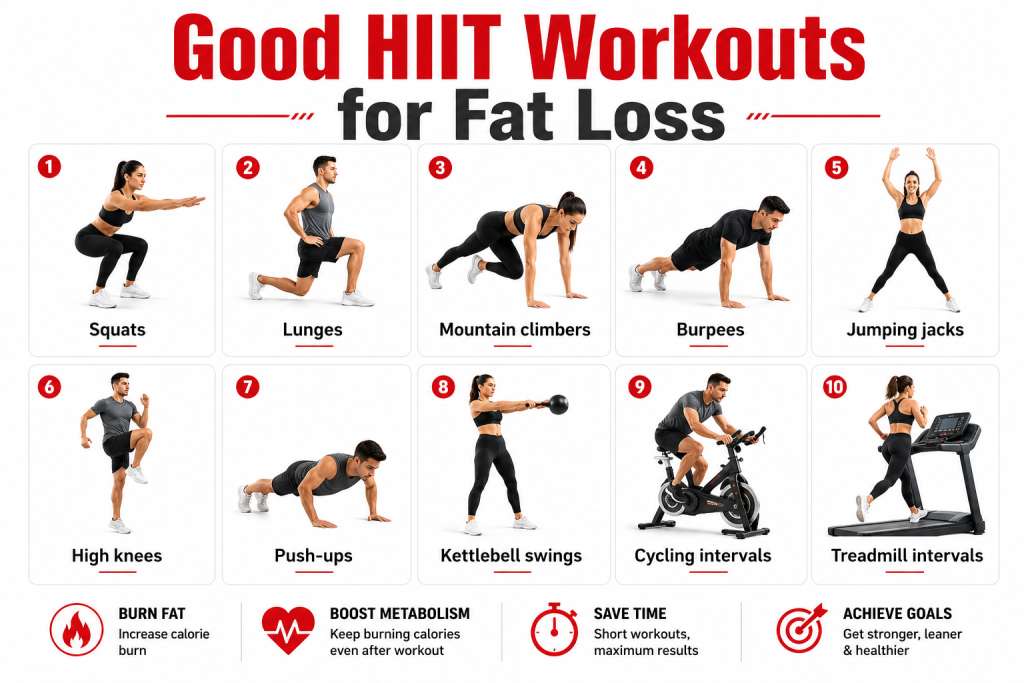
Some good HIIT workouts for fat loss can include:
- Squats
- Lunges
- Mountain climbers
- Burpees
- Jumping jacks
- High knees
- Push-ups
- Kettlebell swings
- Cycling intervals
- Treadmill intervals
Combining upper-body, lower-body, and cardiovascular exercises can create a more balanced session.
If you’re looking for the best HIIT workouts for fat loss, focus on routines that you can perform safely and consistently. A workout that is extremely difficult but leaves you unable to train for several days may not be the most practical choice.
HIIT Cardio Workout for Fat Loss
Cardio equipment can make interval training easier to structure. Treadmills, bikes, rowers, and elliptical machines can all be used for interval workouts.
A simple HIIT cardio workout for fat loss could include:
- Two minutes of easy walking or cycling
- Thirty seconds of faster effort
- Thirty seconds of easy recovery
- Repeat the intervals several times
- Finish with a gradual cooldown
Adjust the intensity according to your fitness level. You should not feel pressured to sprint if walking or jogging intervals are more appropriate for you.
Try a HIIT Treadmill Workout for Fat Loss
A hiit treadmill workout for fat loss can be convenient for people who prefer structured cardio. Begin with a warm-up, followed by short intervals of faster walking or jogging.
For example:
- 2 minutes easy walking
- 30 seconds brisk pace
- 30 seconds easy walking
- 30 seconds faster pace
- 30 seconds recovery
- Repeat
- Finish with a cooldown
Beginners can use incline walking rather than running. More experienced exercisers can increase speed or incline gradually.
Can Strength Training Support Fat Loss?
Yes. Cardio is only one part of a complete fitness program. Strength training can help you develop muscle, improve physical performance, and support a well-rounded exercise routine.
This is where exercises such as squats, deadlifts, presses, rows, and kettlebell movements can complement HIIT Workouts for Fat Loss.
What About Weight Lifting for Belly Fat?
Many people specifically search for Weight Lifting For Belly Fat because they want to reduce abdominal fat. However, you cannot choose exactly where your body loses fat first.
Strength training can help build muscle and improve overall body composition, while nutrition and total activity levels influence fat loss. Combining resistance training with cardiovascular exercise may be more effective for creating a balanced routine than relying on one exercise type alone.
Kettlebell exercises are another option. Swings, goblet squats, cleans, and carries can combine strength and conditioning.
If you enjoy kettlebell training, exploring the Best Kettlebell Workouts for your experience level can add variety to your weekly routine.
HIIT vs. Traditional Cardio
Both HIIT and traditional cardio can have a place in a fitness program.
Traditional cardio often involves maintaining a relatively steady intensity for a longer period. HIIT uses alternating periods of harder and easier effort.
For someone with limited time, HIIT Workouts for Fat Loss may be appealing because they can be completed quickly. However, that does not mean you need to eliminate walking, jogging, cycling, swimming, or other forms of steady-state cardio.
A balanced weekly routine could include:
- HIIT sessions
- Strength training
- Walking or steady cardio
- Mobility work
- Rest and recovery
The best approach is the one you can maintain consistently.
When Should You Do HIIT?
There is no universal best time of day for HIIT. Some people prefer morning workouts, while others have more energy after work.
The important factor is consistency.
If you’re just starting HIIT Workouts for Fat Loss, two or three sessions per week may be a reasonable starting point, depending on your current fitness level and other training. Avoid doing intense sessions every day without adequate recovery.
Your routine should also account for strength workouts, sleep, nutrition, and your overall activity level.
Why Work With a Trainer?
You can find hundreds of workouts online, but choosing the right routine and performing exercises correctly can be difficult. A trainer can help you select exercises based on your goals and fitness level.
A Fat Loss Personal Trainer can also help you create a structured program that combines conditioning, strength training, mobility, and progression, whether that’s through one-on-one sessions or lose weight with bootcamp classes.
This can be particularly useful if you:
- Are new to exercise
- Keep repeating the same workouts
- Need accountability
- Are unsure about exercise technique
- Want a structured fitness plan
- Need modifications for your current fitness level
Personalized coaching can make your workouts more purposeful rather than simply choosing random exercises each day.
Gym Classes to Lose Weight
Some people find group training more motivating than exercising alone. Gym Classes To Lose Weight, such as a 15 minute kettlebell workout, can provide structure, coaching, and a supportive environment.
Group sessions may include:
- HIIT
- Bootcamp
- Strength training
- Circuit training
- Conditioning
- Functional fitness
- Kettlebell training
Weight Loss Bootcamps can also be appealing for people who enjoy energetic group workouts. These sessions often combine strength and cardio movements to create a challenging training environment.
Before joining any class, consider your fitness level and whether the exercises can be modified to match your ability.
Choosing the Best Gym for Weight Loss
The Best Gym For Weight Loss isn’t necessarily the facility with the largest number of machines or the cheapest membership. Look for a gym that offers the training environment, coaching, equipment, and classes that fit your goals.
Consider:
- Qualified coaches
- Strength and cardio equipment
- Beginner-friendly options
- Personal training
- Group fitness classes
- Flexible schedules
- Progress tracking
- A supportive community
If you’re searching locally, comparing the Best Fitness Classes In San Jose can help you identify facilities offering programs that match your preferred training style.
Personal Training in San Jose
For people who prefer individual coaching, Personal Training In San Jose can provide a more customized approach.
A trainer can assess your current fitness level and help organize your weekly training around your goals. Instead of completing the same workout repeatedly, your program can progress as your fitness improves.
At Elite Spartans, for example, people interested in improving fitness and working toward weight-loss goals can explore different training options, including group fitness and personal training. The goal is to create a structured environment where workouts are challenging, progressive, and appropriate for the individual.
How to Make Your 10-Minute Workout More Effective
A short workout does not need to be complicated. Focus on quality, consistency, and progression.
1. Start With a Warm-Up
Even when you only have ten minutes, prepare your body before intense movement.
2. Choose Simple Exercises
You do not need dozens of movements. Pick exercises you can perform correctly.
3. Increase Intensity Gradually
As your fitness improves, you can increase speed, resistance, repetitions, or work intervals.
4. Prioritize Technique
Poor form can reduce exercise quality and increase the risk of injury. Slow down when necessary.
5. Track Your Progress
Record workouts, repetitions, duration, or resistance. Small improvements can help keep you motivated.
6. Combine Training Styles
Don’t rely exclusively on HIIT Workouts for Fat Loss. Add resistance training, walking, mobility, and other enjoyable activities to create a balanced routine.
Common Mistakes to Avoid
Even the best HIIT workouts for fat loss can become ineffective if they are performed incorrectly or without enough recovery.
Doing HIIT Every Day
More isn’t always better. High-intensity exercise requires recovery.
Ignoring Strength Training
Cardio is valuable, but resistance training should also have a place in a well-rounded program.
Skipping Warm-Ups
Starting intense exercise immediately can make the workout unnecessarily difficult.
Using Poor Form
Never sacrifice technique simply to complete more repetitions.
Expecting Instant Results
Fat loss takes time. Consistency with training, nutrition, sleep, and daily activity matters more than one intense workout.
Build a Smarter Fat-Loss Routine With Elite Spartans
If your goal is to become fitter, stronger, and more active, a structured training environment can make the process easier to follow. Elite Spartans can be used as an example of a gym environment where members can combine different approaches, from conditioning and group workouts to strength training and personal coaching.
Instead of relying on random online routines, you can create a weekly program around your goals. This may include HIIT Workouts for Fat Loss, resistance training, cardio, and recovery sessions.
Whether you are looking for the Best Weight Loss Workouts, group training, or one-on-one coaching, the right program should be challenging enough to encourage progress while remaining realistic enough to maintain.
Contact Elite Spartans today to learn more and get started on your fitness journey.
Final Thoughts
You don’t need an hour-long workout every time you exercise. A well-planned 10-minute session can be a convenient way to stay active when your schedule is busy.
HIIT Workouts for Fat Loss can combine short periods of challenging movement with recovery and can be adapted for beginners and experienced exercisers. However, sustainable fat loss is about more than HIIT. Strength training, nutrition, sleep, daily movement, and consistency all contribute to long-term results.
If you want more structure, consider working with a trainer or joining a fitness program. From HIIT Workouts for Fat Loss and kettlebell training to group workouts and personal training, finding an approach you enjoy can make staying consistent much easier.
Ready to take your training seriously? Explore fitness classes, personal training, and workout options at Elite Spartans and find a program that fits your fitness goals.